


Estimated reading time: 12 minutes
Introduction
The squat is one of the first movements CrossFit coaches learn to evaluate. Because it’s a foundational movement, we spend a tremendous amount of time analyzing squat mechanics, identifying movement faults, and determining the best way to correct them.¹
Is it mobility?
Is it motor control?
Those are exactly the questions Zach Long challenged coaches to ask in Dissecting the Squat, and I believe that framework should remain the foundation of every squat assessment.²
But after years of coaching larger-bodied athletes, I found myself asking a different question. What if neither mobility nor motor control fully explains what I’m seeing? What if the athlete has the mobility and understands the movement, but they’re simply working within the mechanical realities of the body they’re bringing to the squat today? That question is what ultimately led me to write this journal.
Research examining functional movement in larger-bodied athletes, particularly movements like the squat, remains surprisingly limited.³ Because of that, some of the ideas presented here are supported by established biomechanics, physics, and the current body of scientific literature.
Others come from years of coaching and studying movement almost exclusively in larger-bodied athletes. When research exists, I’ll lean on it.
It’s also important to remember that larger-bodied athletes aren’t all built the same. Two athletes can weigh exactly the same and move completely differently because of differences in body composition, where they carry their body mass, strength, mobility, training history, confidence, and countless other factors. ³
I’m not suggesting every larger-bodied athlete will move this way. These observations won’t apply to everyone, but I hope they give coaches another way to think about what they’re seeing before deciding how to coach it.
My goal isn’t to challenge science. It’s to build on it, contribute to it, and hopefully encourage more of it. This journal isn’t intended to change the squat standard. It’s intended to help coaches ask better questions before deciding how to help an athlete reach that standard.
If we can better understand the mechanical constraints some larger-bodied athletes experience, we can make better coaching decisions.
Before we correct movement, we first have to understand why the athlete is moving the way they are. For me, that evaluation almost always begins with one question: How is this athlete maintaining balance throughout the squat?
Mass Distribution and Balance
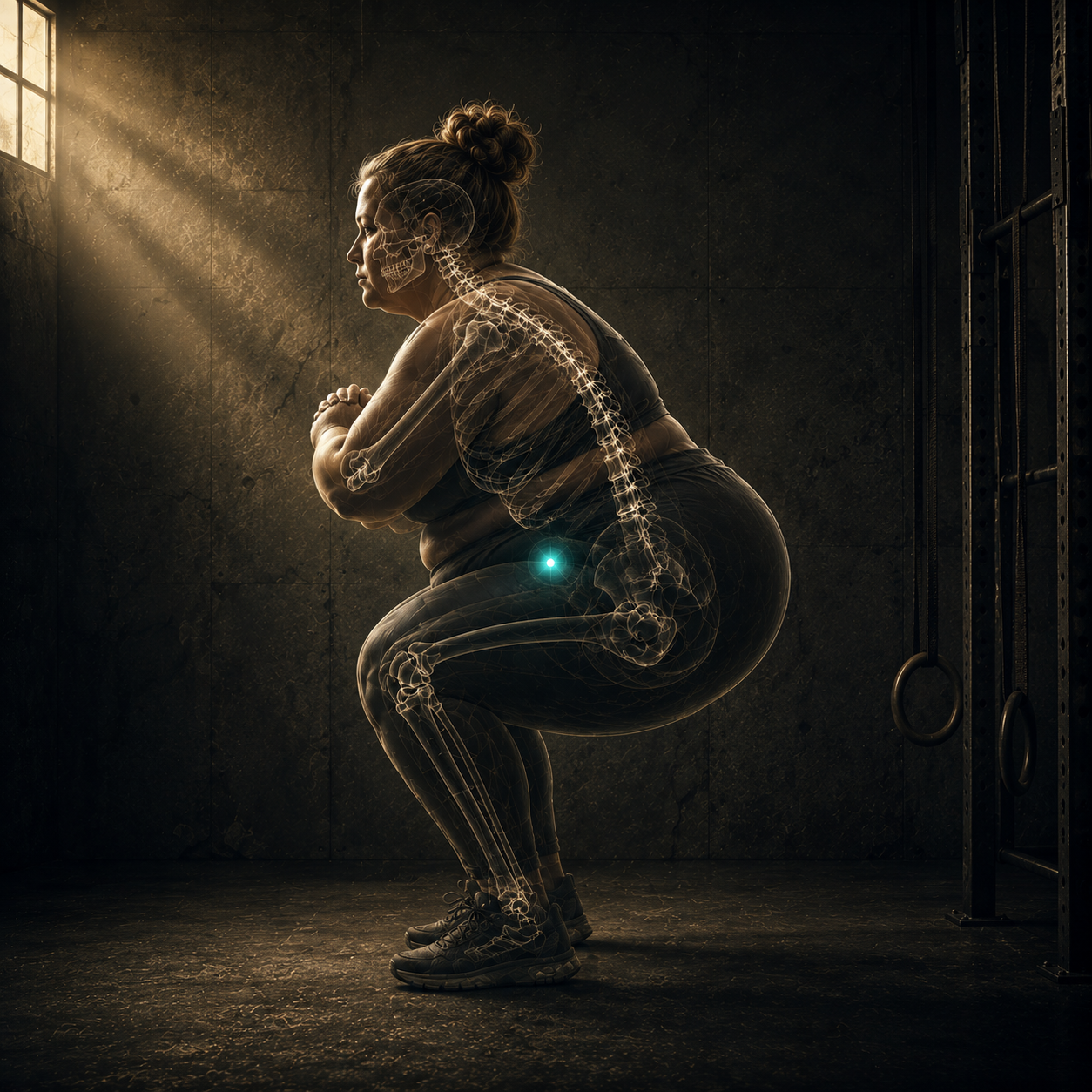
One of the first things I look at when coaching a larger-bodied athlete through the squat is balance. Regardless of body size, every athlete has to keep their center of mass over their base of support throughout the movement. As soon as that relationship changes, the body immediately begins making adjustments to stay upright and avoid losing balance. ⁴ ⁵
That principle doesn’t change for larger-bodied athletes. What often changes is how they maintain that balance. I’ve learned that body weight alone tells us very little about how an athlete will move. Where they carry that weight often tells us much more.
Some athletes carry a greater proportion of their body mass in the abdomen. Others carry more through the hips and glutes. Many carry it throughout their entire body. Those differences don’t change the points of performance or the standard for the squat, but they do influence where an athlete’s center of mass begins before the movement even starts. ⁴ ⁵
Here’s the simplest way to think about it. The body is constantly trying to stay balanced. To make that happen, it instinctively reorganizes itself around wherever the greatest concentration of mass is located. Sometimes that means changing the trunk angle. Sometimes it means changing stance width or foot position. The strategy may look different from one athlete to the next, but the goal is always the same: stay balanced. ⁴ ⁵
These observations haven’t been studied specifically in CrossFit athletes, but they align with established biomechanical principles governing balance and center of mass. ⁴ ⁵
The next two sections explore what that often looks like when an athlete carries more of their weight posteriorly versus anteriorly.
When an Athlete Carries More Weight in the Back (Posterior Mass Distribution)
When an athlete carries more of their weight through the hips and glutes, that additional mass naturally shifts their center of mass farther behind them. To stay balanced throughout the squat, the body often responds by leaning the torso farther forward to bring the center of mass back over the base of support. ⁴˒⁵
At first glance, it’s easy to look at that movement and immediately think, “They’re leaning too far forward,” followed by the instinctive cue, “Chest up.” Sometimes that’s exactly the right cue. Sometimes it isn’t. Before making that correction, it’s worth considering whether the forward lean is actually the athlete’s strategy for staying balanced.
This doesn’t mean coaches should stop pursuing a more upright torso. It simply means we should first determine why the athlete is leaning. If the athlete can improve with a coaching cue, coach it. If they’re already demonstrating the best mechanics available today, the job may be to reinforce sound movement while continuing to build the qualities that allow better movement tomorrow.
Balance, however, is only part of the story. As the athlete continues to descend, another mechanical constraint may begin to influence the squat. We’ll explore that in the next section.
When an Athlete Carries More Weight in the Front (Anterior Mass Distribution)
When an athlete carries more of their weight through the abdomen, that additional mass naturally shifts their center of mass farther forward. Throughout the squat, the body must continually organize itself to keep that center of mass over its base of support. ³˒⁴
As the athlete descends, gravity continues acting on that forward mass, making balance increasingly difficult to maintain. Coaches may see several different movement strategies as the body adapts. Some athletes continue to lean farther forward throughout the movement. Others extend through the lumbar spine in an effort to shift their upper body back. Some may eventually lift the heels from the floor as the body searches for another way to remain balanced while continuing to descend.
Just as with posterior mass distribution, it’s easy to look at these compensations and immediately start correcting them. Before doing so, ask yourself why they’re happening.
Soft-Tissue Approximation
Balance, however, isn’t the only mechanical consideration. As the athlete continues to descend, another physical constraint may begin to influence the movement.
As a larger-bodied athlete descends into the squat, there may come a point where the movement runs out of space. Most commonly, the abdomen meets the thighs, physically limiting further hip flexion. In other athletes, the glutes or backs of the thighs may meet the calves, limiting further knee flexion as the knees continue to bend. When that happens, the movement isn’t necessarily stopping because the hip or knee joint has reached its available range of motion. It may be stopping because the body has literally run out of space. ⁶˒⁷
That’s an important distinction because a lack of available space isn’t the same thing as a lack of mobility.
This is known as soft-tissue approximation, and it’s an important concept for coaches to understand. The joint itself may still possess additional range of motion, but the surrounding soft tissue prevents the athlete from continuing the movement in the same way. ⁵˒⁷
Soft-tissue approximation is one example of what I’ll refer to throughout this article as a temporary mechanical constraint. These constraints aren’t necessarily permanent. As an athlete’s body changes over time, the constraint may change as well. Rather than assuming every athlete who struggles to reach depth has a mobility restriction, coaches should first consider whether available space has become the limiting factor.
In some cases, a simple adjustment to stance width or foot position may create enough additional space to improve the movement without changing the standard. Understanding why those adjustments work begins with recognizing where the available space is being lost.
Anterior Soft-Tissue Approximation
When the abdomen meets the thighs, further hip flexion may become mechanically limited. The hip joint itself may still possess additional range of motion, but the surrounding soft tissue has eliminated the space needed to continue moving. ³˒⁵
At that point, the athlete may have reached the deepest position they can currently express while maintaining sound mechanics. Continuing to force greater depth may simply cause the body to look for movement somewhere else.
Posterior Soft-Tissue Approximation
A similar situation can occur in the back of the body. When the glutes or backs of the thighs meet the calves, further knee flexion may become mechanically limited. ³˒⁵
If the athlete continues trying to descend, the body may look for another strategy to keep moving. Depending on the athlete, that compensation may appear as a change in ankle angle, a shift in stance width, a shift in foot position, a shift in trunk position, or, in some athletes, the heels lifting from the floor. The exact strategy will vary, but the goal remains the same: find another way to continue the movement after the available space has been exhausted. ³˒⁴˒⁵
If the athlete continues to try to reach greater depth, one common strategy is rotating the pelvis underneath the body, creating movement through the lumbar spine instead of the hip. In CrossFit, we often recognize this compensation as a butt wink. ³˒⁵˒⁸
Seeing What the Body Is Actually Doing
On a lean athlete, a butt wink is usually easy to spot because the bony landmarks are clearly visible. On a larger-bodied athlete, those same landmarks may be hidden beneath additional soft tissue, making compensations like a butt wink much more difficult to recognize. ³˒⁸
This is where coaching becomes especially important. If movement continues by sacrificing sound mechanics, such as allowing the heels to lift or the spine to round, the coach should intervene. But if the athlete has reached the deepest position they can currently achieve while maintaining balance, spinal organization, and control, forcing additional depth may simply create a new movement fault rather than improve the squat.
The goal hasn’t changed. Continue pursuing better movement while recognizing what is limiting the athlete today. As strength, confidence, mobility, and body composition change over time, that limitation may change too.
Breathing, Bracing, and Pressure
Movement isn’t influenced only by balance and available space. The ability to breathe and maintain an effective brace can also shape how an athlete moves throughout the squat.
The squat places significant demands on trunk stability. We teach athletes to brace the trunk to create a stable platform for movement. That principle doesn’t change for larger-bodied athletes.
What changes are the mechanical demands placed on the body while trying to create and maintain that brace. ⁹˒¹⁰˒¹¹
Just as body mass distribution can influence balance and soft-tissue approximation can influence available space, abdominal compression may also influence an athlete’s ability to breathe and maintain an effective brace throughout the squat.
Research has shown that obesity alters respiratory mechanics and increases the work of breathing during exercise. As the hips flex during the squat, abdominal compression naturally increases. For athletes carrying greater abdominal mass, that compression may occur earlier in the movement and become more pronounced as depth increases. ¹²˒¹³
As available space within the torso decreases, maintaining an effective brace while breathing may become more mechanically demanding. Increased abdominal compression may also make it more difficult to take a full diaphragmatic breath while maintaining trunk stability. ⁹˒¹⁰˒¹¹˒¹²˒¹³
As a result, coaches may notice athletes pausing more frequently between repetitions, resetting their breath before descending again, or shortening the range of motion as fatigue accumulates. These responses shouldn’t automatically be interpreted as poor conditioning or a lack of effort. In many cases, the athlete may simply be trying to re-establish an effective brace before beginning the next repetition while managing greater respiratory demand.
As with every other aspect of the squat, observation should guide intervention. Before assuming an athlete simply needs better conditioning, ask whether breathing mechanics may be contributing to what you’re seeing.
Together, balance, available space, and breathing mechanics represent three additional considerations that may help coaches better understand how a larger-bodied athlete expresses the squat.
Conclusion
The principles of the squat don’t change simply because an athlete lives in a larger body. A neutral spine, balanced foot pressure, and proper knee tracking still matter. CrossFit’s standard of virtuosity hasn’t changed. ¹
What this article proposes isn’t a different standard. Zach Long challenged coaches to determine whether a movement limitation stemmed from mobility or motor control, and I believe that framework should remain the foundation of every squat assessment. ² My hope is that this journal adds one more question to that framework: Could the athlete be working within a temporary mechanical constraint?
Before assuming every visible movement fault represents dysfunction, consider whether body mass distribution, soft-tissue approximation, or the mechanical demands of breathing and bracing may be influencing what you see. Recognizing those influences doesn’t lower the standard; it improves the diagnosis.
When coaches understand why an athlete is moving the way they are, they’re far more likely to choose the right intervention. That intervention might be a mobility drill, a coaching cue, or something as simple as adjusting the athlete’s stance or foot position. In other cases, it may mean recognizing that the athlete is already expressing the highest-quality squat they can safely achieve right now while continuing to develop the qualities that will expand their options over time.
Larger-bodied athletes need coaches who can recognize the difference between a movement fault that should be corrected right now, or a limitation that may improve with strength, mobility, confidence, and changes in body composition. Good coaching has never been about forcing every athlete into the same solution. It’s about understanding why the movement looks the way it does before deciding how to improve it.
references
¹ Glassman G, CrossFit Staff. CrossFit Level 1 Training Guide. CrossFit, Inc.; 2010.
² Long Z. Dissecting the squat. CrossFit Journal. 2016 Dec 27.
³ Neumann DA. Kinesiology of the Musculoskeletal System: Foundations for Rehabilitation. 3rd ed. St. Louis, MO: Elsevier; 2017.
⁴ Winter DA. Biomechanics and Motor Control of Human Movement. 4th ed. Hoboken, NJ: John Wiley & Sons; 2009.
⁵ Shumway-Cook A, Woollacott MH. Motor Control: Translating Research into Clinical Practice. 5th ed. Philadelphia, PA: Wolters Kluwer; 2017.
⁶ Escamilla RF. Knee biomechanics of the dynamic squat exercise. Medicine & Science in Sports & Exercise. 2001;33(1):127-141. doi:10.1097/00005768-200101000-00020.
⁷ McGill SM. Low Back Disorders: Evidence-Based Prevention and Rehabilitation. 3rd ed. Champaign, IL: Human Kinetics; 2016.
⁸ Cholewicki J, Juluru K, McGill SM. Intra-abdominal pressure mechanism for stabilizing the lumbar spine. Journal of Biomechanics. 1999;32(1):13-17. doi:10.1016/S0021-9290(98)00129-8.
⁹ Hodges PW, Eriksson AEM, Shirley D, Gandevia SC. Intra-abdominal pressure increases stiffness of the lumbar spine. Journal of Biomechanics. 2005;38(9):1873-1880. doi:10.1016/j.jbiomech.2004.08.016.
¹⁰ Salome CM, King GG, Berend N. Physiology of obesity and effects on lung function. Journal of Applied Physiology. 2010;108(1):206-211. doi:10.1152/japplphysiol.00694.2009.
¹¹ Littleton SW. Impact of obesity on respiratory function. Respirology. 2012;17(1):43-49. doi:10.1111/j.1440-1843.2011.02096.x.



A must read for my fellow coaches!
<3